Rethinking AI: Why the Smallest LLMs Might Be the Most Powerful
Not every AI needs to be the most powerful. Smaller LLMs can guide, organize, and refine tasks, making big models more effective. By using AI strategically and combining models, you can save cost, increase efficiency, and unlock creativity in ways that raw power alone cannot achieve.
posted by  Sink
Sink
In today’s world, AI has captured our attention in ways that are both exciting and overwhelming. Everywhere you look, people are chasing the newest, flashiest, most powerful large language models, asking which one is best for coding, writing, or even generating art. The frenzy is real, and it is easy to get caught up in the race for the cutting edge.
Amid all this hype, I have noticed something curious. While everyone is focused on raw power, very few people pause to think about the fundamentals of AI. Sometimes it is not about having the smartest tool. It is about using the tools you already have in smarter ways. Even smaller, older, or less impressive LLMs can create massive value when approached differently.
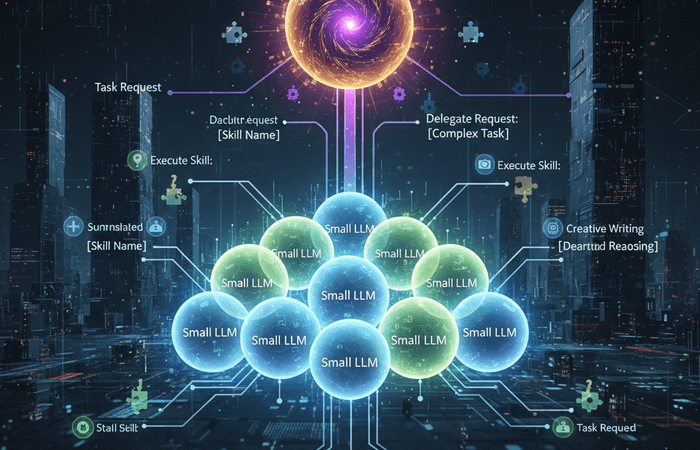
Consider this idea: what if we did not always throw the biggest, most advanced model at a problem first? What if we used smaller LLMs as orchestrators, deciding how and when to use other models? Imagine a tiny AI acting like a receptionist. It does not need to write perfect code or craft a flawless essay. All it does is take your idea and guide it to the right AI next. It provides direction and routes the task to the model that can handle it best.
This receptionist AI is just one example of a broader approach. Not every LLM needs to be a genius. Some can focus on decision-making, organizing tasks, or formatting text, while others execute specific skills. You can break a task into multiple stages, with each LLM performing a different role. One model can review, another can write, another can think, and another can execute. Even smaller models can make meaningful contributions that drive the workflow forward.
A practical example is prompt refinement. Suppose you want to generate code or write an article. Instead of asking a massive LLM to do everything in one step, you can start with a smaller model to improve your prompt. It can clarify your intentions, remove ambiguity, or restructure your instructions. You can even use multiple small models to refine the prompt from different perspectives. By the time you feed it to a more powerful LLM, you have created a “mega prompt” capable of producing better results in fewer steps and at lower cost.
Another example involves skill routing. Many AI systems allow you to define skills, which are commands or actions the AI can trigger. Instead of relying on a single large model to decide which skill to use, you can have smaller LLMs make those decisions. One model chooses the next step, another decides which service to call, and another formats the output. The system as a whole becomes smarter than any one model alone while keeping each part simple and manageable.
This approach is practical and effective. Smaller models are faster, cheaper, and easier to experiment with. They allow you to try different approaches, test new ideas, and iterate quickly without incurring high costs. In some cases, they even outperform larger models on specific tasks because they can focus, specialize, and avoid unnecessary complexity.
Personally, I have found this mindset to be transformative. Instead of obsessing over the “best AI,” I started thinking about how to combine models to maximize efficiency and creativity. I experimented with tiny models as organizers, refiners, and guides, and the results were often surprising. Sometimes the smallest model in the system ends up carrying the most weight in managing the workflow, freeing the bigger models to shine where they are needed most.
The main takeaway is that AI is not just about raw power. It is about strategy, orchestration, and using tools intelligently. Smaller LLMs can take on roles such as decision-making, formatting, or guiding prompts, while the larger models handle tasks that require their scale and knowledge. Thinking in this way allows you to build AI systems that are smarter, cheaper, and more creative without getting lost in the frenzy of chasing the latest models.
The next time you hear someone ask which LLM is the best, think about the bigger picture. Sometimes the answer is not about which model is the smartest, but about how you use all of them together. Even the simplest AI can make a huge difference when it plays the right role.